
ENGINEERING RESOURCES / OEM DECISION GUIDE
Axial flux motor: make or buy?
An axial flux motor make-or-buy decision is a choice about the work you can own. Compare complete motors, active-part kits and custom builds against one controlled system brief.
By YokelessMotor · Published · Reviewed
THE ENGINEERING DECISION
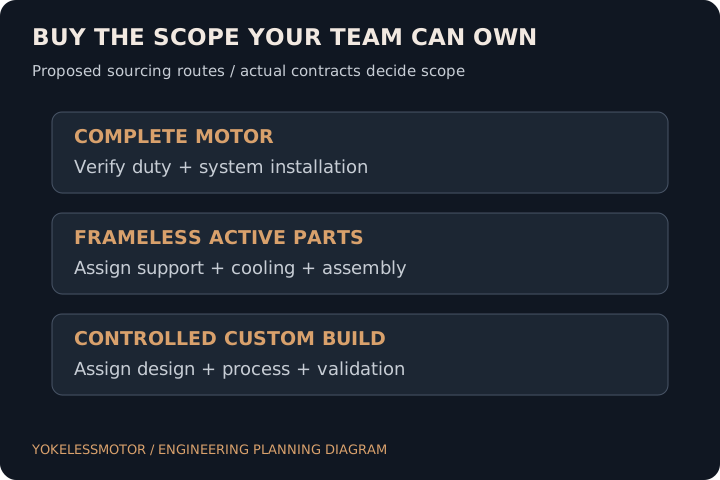
Start with a documented complete motor if its verified interfaces and duty fit. Consider a frameless kit when your team can own the missing mechanical and thermal integration. Use build-to-print or custom development when the design requirement justifies the additional design authority, process and validation work.
See method and primary sourcesPublic scope is evidence
A supplier website supports a conversation; stock and commercial terms still need confirmation.
Assign every interface
A rotor-stator kit leaves assembly, support and system validation work to allocate.
Cost the full programme
Include NRE, integration, test, changes and future supply alongside unit cost.
1. Choose a deliverable before choosing a supplier
A complete motor, a frameless active-part set and a drawing-controlled component are different deliverables. Compare them against the same required system duty and interface record. The lowest quoted component price may leave substantial integration work outside the purchase order.
The matrix below is our procurement framework. Actual responsibility can move between buyer, motor supplier, contract manufacturer and test partner. Name an accountable owner for every open item rather than assuming it follows the physical parts.
| Route | Useful when | Buyer must resolve |
|---|---|---|
| Documented complete motor | Verified duty and interfaces fit the package | System installation, drive pairing and application validation |
| Frameless rotor / stator kit | The system can provide mechanical support and heat removal | Bearings, gap, retention, housing, sensing and assembled verification |
| Build-to-print components | A controlled design and acceptance method already exist | Design authority, manufacturability changes and final motor release |
| Custom motor development | No available documented option meets a justified requirement | Requirements, NRE, design gates, iterations and validation ownership |
2. Check public commercial scope without inferring availability
As checked on 21 October 2026, YASA’s P400R / 750R page describes commercial off-the-shelf motors and invites discussions with prospective partners. Its separate series page describes a 1,000-plus annual-volume context. These are different public scopes; neither proves stock for a particular enquiry. A blanket claim that external customers cannot buy any YASA motor is not supported by these pages.
EMRAX publishes motor documents and an enquiry route. Allient lists a frameless axial-flux SA series for low-profile applications. These examples establish that documented complete motors and axial kits are distinct public options. They do not establish equivalence of topology, duty, interfaces or procurement terms, or an independent supplier ranking.
| Official source | What is publicly described | Ask directly |
|---|---|---|
| YASA P400R / 750R | COTS motors and prospective partner discussions | Current build configuration, sample quantity, schedule and terms |
| YASA series programme | Series-motor positioning at 1,000+ motors per year | Applicability to your programme and development scope |
| EMRAX document archive | Motor data, installation manual and controller references | Exact revision, cooling / winding option and quoted availability |
| Allient frameless range | SA axial-flux kits for low-profile applications | Integration scope, performance fit and commercial configuration |
3. Allocate missing interfaces before requesting kit prices
Allient describes frameless integration with customer-supplied mechanical components. For an axial arrangement, the supplied parts alone do not close the complete assembly question. Agree who controls rotor support, axial gap and deformation, bearings, cooling, feedback and protection.
For build-to-print, also name the design authority and the process-change approver. A supplier’s dimensional inspection confirms only the contracted component characteristics. It does not automatically approve the electromagnetic design, rotating assembly or complete motor duty.
| Work item | Complete motor | Kit / build-to-print |
|---|---|---|
| Electromagnetic design and winding revision | Confirm supplier design boundary | Assign design authority and permitted changes |
| Bearings, rotor support and axial gap | Confirm included mechanical limits | Assign assembly design and inspection owner |
| Cooling, insulation and sensor integration | Confirm installation conditions | Assign thermal / electrical design and evidence |
| Drive configuration and protection | Agree motor / drive interface | Assign parameter identification and commissioning |
| Final system acceptance | Assign application integration owner | Assign assembled motor and application test owners |
4. Compare total programme cost with uncertainty visible
A useful comparison model is Ctotal(N) = Cnonrecurring + N × Cdelivered-unit + Cintegration + Cvalidation + Cchanges + Csupply-support. Define what each term includes so test fixtures or packaging are not counted twice. Currency, tax, logistics, scrap and timing assumptions must be consistent.
This model is our accounting framework, not quoted market pricing. If a term is unknown, request a range or mark it unresolved. A break-even quantity calculated from two unit prices alone ignores the very work a kit or custom route transfers to the buyer.
| Cost bucket | Include explicitly | Question that changes the decision |
|---|---|---|
| Nonrecurring work | Design, tooling, fixtures and first-article preparation | Who owns it and what happens after a revision? |
| Delivered unit | Parts, assembly, agreed inspection, packaging and logistics boundary | Are all suppliers quoting the same scope and quantity? |
| Integration / validation | Internal engineering, drive setup, test hardware and test time | Which work remains outside the purchase order? |
| Change / supply support | Requalification, substitutions, repair strategy and future documentation | What is committed versus an estimate or open issue? |
5. Stress-test the route with two development scenarios
Hypothetical scenario A: an early vehicle prototype has room for a documented complete motor and the team needs shaft-level results quickly. First check its actual duty and drive fit. A custom rotor with lower piece cost may consume integration and validation capacity that this programme does not have.
Hypothetical scenario B: a motor OEM has a controlled electromagnetic design and an in-house dynamometer but needs repeatable stator and rotor manufacture. A scoped build-to-print route may fit, provided process substitutions, inspection and assembly release responsibilities are explicit. It is not automatically a reason to outsource the complete design.
| Programme constraint | Route to examine first | Gate before commitment |
|---|---|---|
| Limited motor integration team; package fits | Documented complete motor | Verify duty, mounting, cooling and drive interface |
| Owned design and test team; manufacturing gap | Drawing-controlled subassemblies | Agree CTQs, process route and final acceptance ownership |
| Unique envelope; design still moving | Feasibility study before production tooling | Close architecture and evidence gaps before recurring-price commitment |
6. Resolve design rights and change control early
Before transferring detailed geometry, confirm the parties, information scope and agreed confidentiality process. An NDA request is a request to arrange an agreement; it does not prove execution or permission to manufacture another party’s design. IP and contract terms require project-specific review.
Record ownership and permitted use of drawings, winding data, tooling and test results. Define how proposed substitutions or geometry changes are approved and which checks must repeat. If a previous supplier’s product is the reference, do not treat a matching mounting pattern as evidence of electrical, thermal or functional interchangeability.
- Name drawing owner, design authority and revision approver.
- Record confidentiality status before proprietary transfer.
- Agree tooling access, data deliverables and permitted use.
- Define substitution notification, requalification and release records.
- Validate any replacement at the actual system interfaces and duty.
7. Issue one brief and compare evidence gaps
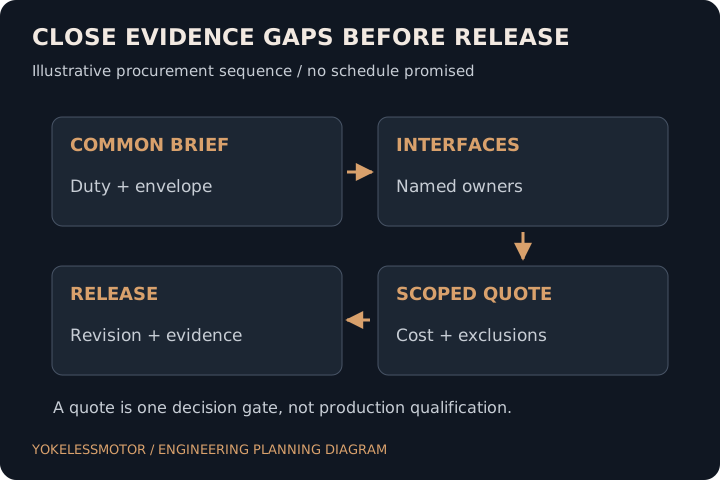
Send the same non-confidential duty, envelope, quantities and acceptance goals to each candidate. Ask them to return an included / excluded scope, an interface register, a development plan and a list of unresolved inputs. Treat a public catalogue or polished diagram as a starting point for questions.
For material-origin or export questions, record the actual item, material information, destination and intended use for qualified review. An assembled rotor or a “heavy-rare-earth-free” description alone does not establish an exemption or a guaranteed shipping date. This guide provides no legal classification or clearance promise.
| Gate | Evidence to agree | Release decision |
|---|---|---|
| Feasibility | Duty, interface ownership, exclusions and open issues | Is this route credible for the requirement? |
| Prototype | Controlled revision, agreed component checks and assembled test plan | Does the built configuration meet its scoped criteria? |
| Repeat supply | Change control, traceability, recurring checks and commercial agreement | Can the accepted configuration be ordered consistently? |
8. Method, evidence limits and the next decision
Reviewed on 21 October 2026. Supplier statements above are a dated snapshot of their official public descriptions. We have not obtained current project quotations, confirmed inventory, audited factories or tested equivalent models. No supplier has authorised or endorsed this independent guide.
The sourcing, responsibility and cost tables are our editorial framework. YokelessMotor offers a requirements-led discussion of motor and component programmes; the website does not establish stocked configurations, verified ratings, a signed NDA or approved replacement CAD. Select the next enquiry scope from your team’s design and test capability, then close the evidence gaps.
- System team: compare all routes against one controlled duty.
- Buyer: request scoped quotations and unresolved commercial conditions.
- Design / test owners: approve interfaces and evidence before release.
SELECTION QUESTIONS
Questions engineers ask.
Does YASA no longer supply external customers?
A blanket withdrawal is not supported by the official pages checked on 21 October 2026. They describe COTS motors and partner discussions; availability for your quantity and configuration still requires direct confirmation.
Does a catalogue listing prove stock?
No. Confirm the exact revision, configuration, sample quantity, schedule and commercial terms with the supplier.
When should I start with a complete motor?
When its documented duty and interfaces fit and the programme benefits from buying a defined assembly. System integration and application validation still need an owner.
What does a frameless kit leave to the integrator?
The exact scope varies, but mechanical support, bearings, gap, rotor retention, cooling, sensing and assembled verification need explicit allocation.
Is every axial-flux kit a yokeless segmented motor?
No. Axial flux names the working flux direction. Core, winding and rotor-stator constructions vary; confirm the actual architecture.
When does build-to-print make sense?
When a controlled design, design authority and acceptance plan exist and the outsourced manufacturing scope is clear. Final motor release remains a separately assigned responsibility.
Is a custom motor cheaper at low volume?
No general cost claim is supported here. Compare nonrecurring work, units, integration, validation, changes and supply support using consistent scope and quantities.
Can I calculate break-even from unit price alone?
That omits transferred engineering and verification work. Use a complete programme-cost model and keep unknown terms visible.
Does an NDA request allow confidential CAD transfer?
It records the need to arrange confidentiality. Confirm the actual agreement and transfer process with the identified parties before sending proprietary material.
Does the same mounting pattern prove a drop-in replacement?
No. Duty, winding, drive, sensing, cooling, mechanical loads and protective behaviour also need to be compared and validated.
Can an assembled rotor guarantee simpler export clearance?
This guide makes no such guarantee. Actual item, material, destination and intended use need qualified review under the applicable requirements.
What should my first sourcing enquiry contain?
Send non-confidential duty and envelope, desired deliverable, quantities, timing, acceptance goals and the design / test work your team can own. Ask for a clear included and excluded scope.
Primary sources and review scope.
Sources checked on 21 October 2026. External manufacturer descriptions apply to their own products. The analysis, decision tables and hypothetical examples in this guide do not constitute a YokelessMotor test report or a certification claim.
- YASA: P400R and 750R commercial motor page
Official public description of COTS motors and prospective partnerships, checked 21 October 2026. It neither proves stock nor supports a blanket external-supply withdrawal.
- YASA: series motor programme
Distinct public positioning for annual volumes of 1,000+ motors. No price, sample access or supply commitment is inferred.
- EMRAX: official document archive
Public motor datasheets, installation manual and controller references. Confirm offered build revision and availability directly.
- Allient: SA series frameless axial-flux motors
Specific SA public application scope: low-profile camera, gimbal and imaging systems, with modified/custom discussion offered. No propulsion equivalence or exact contracted kit contents are inferred.
- Allient: frameless motor range and SA axial-flux series
Official frameless and SA axial-flux scope. Illustrates a distinct integration boundary; does not establish equivalence to a propulsion motor or our supply capability.
TURN THE COMPARISON INTO A BRIEF
Bring the constraints that matter.
Start with non-confidential duty, package, quantities and acceptance requirements. Request an NDA before detailed drawings. The next step is a scoped feasibility discussion.
Discuss your motor sourcing scope