
Choose the core route first
Compare a pressed SMC tooth with a laminated electrical-steel stack against your flux path, excitation frequency and loss data. Request grade-specific curves; the material family alone does not establish efficiency.
CORE COMPONENTS / DRAWING-LED REVIEW
Request segmented stator manufacturing review from individual teeth to a wound and encapsulated assembly. Define the magnetic path, insulation and thermal interface before committing to tooling.
OEMs and R&D teams · Components or subassemblies · Scope confirmed after review
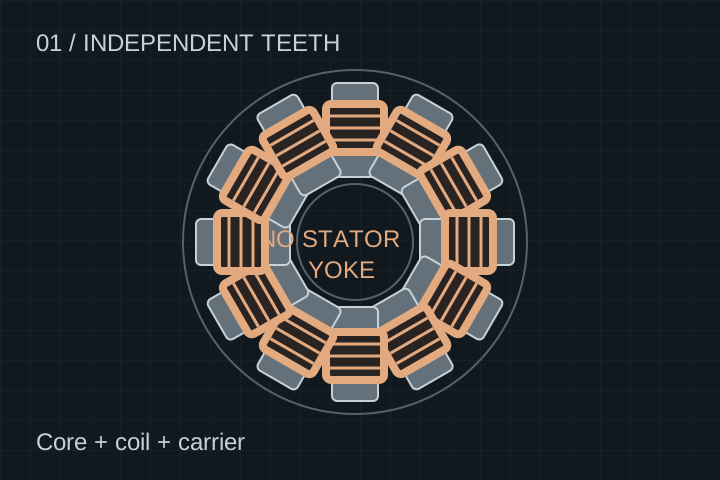
DESIGN TO MANUFACTURING
Tooth orientation, cut-edge condition, winding access and resin thickness interact. A part that meets its outer dimensions can still miss the intended magnetic or thermal behavior. Bring the loss model, coil envelope and cooling boundary into the same DFM review.
Compare a pressed SMC tooth with a laminated electrical-steel stack against your flux path, excitation frequency and loss data. Request grade-specific curves; the material family alone does not establish efficiency.
Request bare teeth, insulated cores, wound segments or a carrier assembly. State who owns the winding drawing, conductor choice, termination and phase connection so the quotation covers the same deliverable.
Define coil-to-carrier contact, insulation and encapsulant requirements together. A resin thermal-conductivity headline does not establish the assembly thermal resistance or continuous current limit.
DFM / SCOPE & COST DRIVERS
This is a DFM screening matrix, not a ranking of material performance. Confirm process availability, tooling and validation in the quotation.
| Decision | SMC tooth route | Laminated tooth route |
|---|---|---|
| Magnetic path | Review three-dimensional flux, density and grade-specific B-H/loss curves. | Review lamination orientation and the flux component crossing insulated layers. |
| Prototype route | Agree sample process and whether dedicated pressing tooling is required. | Compare cut laminations and stacking fixtures with production stamping economics. |
| Manufacturing controls | Specify density, heat treatment, edge integrity and allowable handling damage. | Specify sheet grade/thickness, burr direction, coating and stack fixation. |
| Winding access | Check tooth shape, insulation coverage and coil insertion sequence. | Check corner protection, stack alignment and conductor bend clearance. |
| Cost separation | Quote tooling, samples and recurring parts separately; do not assume zero tooling. | Separate cutting/stamping setup, stacking labor, winding and inspection. |
AGREE THE EVIDENCE
A manufacturing review does not validate an electromagnetic model. Core loss, insulation life and continuous torque require an agreed component or motor test plan. Grain-oriented steel is a design-specific option, not an automatic upgrade.
Air-gap metrology & quality gates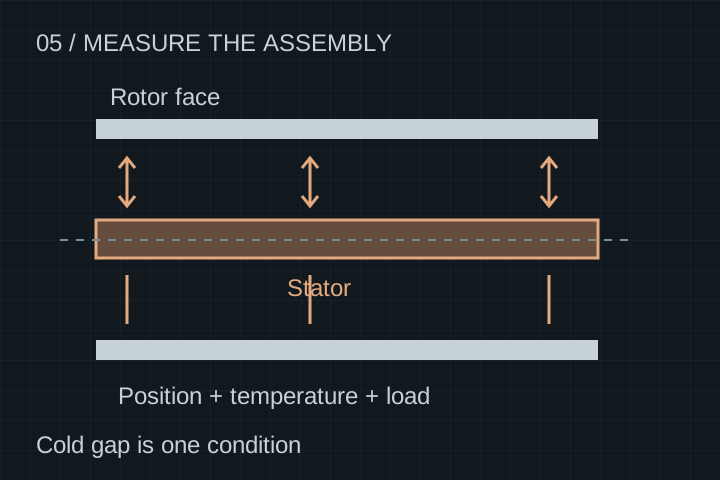
START WITH NON-CONFIDENTIAL INPUTS
Send the scope and operating envelope first. Request an NDA before sharing proprietary artwork or detailed CAD. The next step is scope clarification and feasibility review; pricing and timing follow the agreed deliverable.
ENGINEERING FAQ
Yes. Select a bare-core scope and identify the drawing, material, quantity and acceptance records. Winding, insulation, carrier assembly and potting can be scoped separately.
No. Compare the actual flux path, frequency, loss curves, geometry, tooling and mechanical requirements. SMC can support three-dimensional magnetic paths; that does not establish lower loss in every design.
Include the conductor specification, turn count, bend limits, frequency and termination method. Feasibility and the winding process are confirmed after reviewing coil access and insulation requirements.
Ask for tooling/NRE, samples, recurring part cost, winding/encapsulation, inspection, documentation and delivery assumptions as separate items. Pricing and lead time follow the reviewed scope.
RELATED COMPONENTS
Material background: insulated powder particles permit three-dimensional magnetic circuit design. This reference does not verify our supply of a particular grade. Höganäs: soft magnetic materials.
Published / reviewed 20 October 2026 · YokelessMotor engineering content · Illustrations and planning guidance, not measured production results. About the project.