
DECISION / 01
Choose the hand-off point
Order a core, wound stator, magnetized rotor, machined housing or integrated sample. Name which party owns assembly interfaces and the final air gaps.
APPLICATION ENGINEERING / OEM & R&D
Keep electromagnetic design authority in your team. Define a manufacturable stator, rotor, housing or PCB scope with controlled revisions and an agreed sample evidence package.
Component, assembly or custom motor scope · Reviewed 20 October 2026
START WITH THE CONSTRAINTS
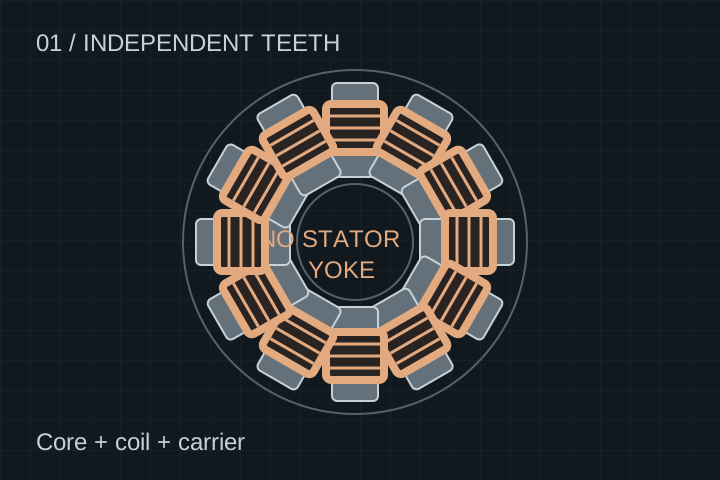
A segmented stator design still needs a finished-core route, insulation stack-up, winding access, impregnation and datums. A rotor concept needs magnet orientation, retention, adhesive and runout controls. Turn the design into a bounded work package before commissioning samples or comparing supplier quotes.
DECISION / 01
Order a core, wound stator, magnetized rotor, machined housing or integrated sample. Name which party owns assembly interfaces and the final air gaps.
DECISION / 02
Compare SMC pressing or laminated steel as a geometry, material and processing choice. Specify winding, insulation, potting and inspection rather than procuring only a material name.
DECISION / 03
Link the sample to a drawing revision, material records and agreed checks. Define who approves deviations, owns tooling and receives test data before work starts.
REQUIREMENT → EVIDENCE
Use this proposed review matrix to identify what is known, what needs a test and who can approve the result. Acceptance limits are agreed for your project.
| Work package | Design hand-off | Sample evidence |
|---|---|---|
| Segmented core / stator | Core geometry, material route, stack or pressing requirements and datums | Agreed dimensional checks and material / process records |
| Winding and potting | Turns, conductor, termination, insulation system and thermal interfaces | Connection / resistance checks, insulation tests and potting inspection to an agreed plan |
| Magnet rotor | Magnet geometry and orientation, grade data, back iron and retention concept | Orientation / polarity checks, dimensional records and commissioned retention evidence |
| Housing and bearing interfaces | Fits, geometric tolerances, sealing features and inspection datums | Revision-linked dimensional report; assembly tolerance review if included |
| Integrated prototype | Assembly ownership, air-gap stack-up, sensor and cooling interfaces | Agreed electrical / mechanical bench evidence, separate from production qualification |
| NRE and recurring supply | Sample quantity, design maturity, forecast, tooling and data ownership | Separated engineering / tooling / unit items and change-control terms |
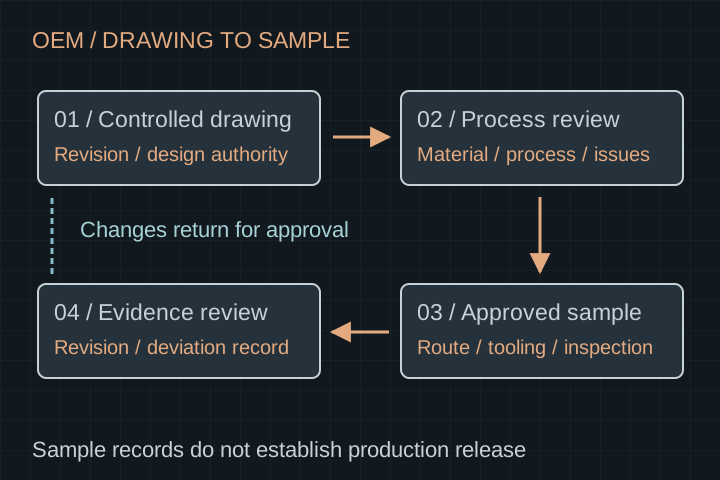
Suppose drawing Rev B reduces a bearing-seat tolerance after Rev A samples were ordered. Record the request, check the process and inspection impact, then approve the quotation and drawing change before manufacturing the next sample. Keep Rev A results attached to Rev A.
A drawing change can affect tooling, datum strategy, lead time and sample acceptance. Agree who can authorize a deviation; an informal email description should not silently replace the controlled drawing.
SUPPLY AND INTEGRATION
| Decision | Customer design owner | Manufacturing review scope |
|---|---|---|
| Electromagnetic design | Geometry, operating targets and performance acceptance | Manufacturability feedback; redesign only if separately commissioned |
| Material and process | Approve specified route, substitutions and critical characteristics | Propose a defined route and identify available records / inspection limits |
| Tooling and data | Agree ownership, permitted use and required deliverables | Itemize tooling, engineering outputs and agreed retention / hand-over terms |
| Deviation and release | Authorize design changes and accept / reject sample evidence | Record nonconformities and obtain approval before implementing departures |
REVIEW / 01
NDA discussion if needed, document list, design authority and scope boundaries.
REVIEW / 02
Material / process proposal, open issues, acceptance plan and separated NRE / tooling items.
REVIEW / 03
Revision-linked report, deviation disposition and approved next-build instructions.
A manufacturing review does not transfer design authority or establish qualified production. NDA execution, IP rights, tooling ownership, inspection scope and data retention require explicit agreement. Do not submit proprietary drawings through the public requirements form.
Review air-gap and inspection planningFIRST CONVERSATION / NON-CONFIDENTIAL
Your inquiry opens the requirements discussion. We first identify missing inputs and the requested deliverables; feasibility, price, schedule and verification work need a project-specific agreement.
The contact form carries this application and source page. Request an NDA before sharing proprietary drawings. It records requirements and does not upload CAD or execute an agreement.
Scope an OEM component project Download the application worksheetDefine finished-core, winding and potting interfaces.
Review segmented stator and winding scopeSpecify magnets, retention, assembly and inspection.
Review magnet rotor assembly scopeCompare material data with the actual manufacturing route.
Review smc versus laminated steelYes, scope the inquiry around your controlled design and named manufacturing work package. Any design changes, simulations or redesign deliverables need explicit approval and a separate scope where appropriate.
Yes, request a bounded component review. Define assembly datums, supplied and mating parts, inspection needs and responsibility for the final air gap, balancing and system tests.
No universal preference is stated. Compare the actual geometry, local flux paths, excitation, grade, processing and finished-core evidence. The linked material guide provides a selection framework.
No. It records your request to discuss an NDA before proprietary information is shared. Exchange and execute an agreed document separately before sending confidential drawings.
Agree ownership, access, permitted use, maintenance and hand-over terms in the quotation or contract. The site does not assign those rights automatically; list the records and files you need as deliverables.
No. Sample inspection answers only the agreed checks on identified parts. Repeatability, process controls, production acceptance and system qualification require their own scope and evidence.
Reviewed by the YokelessMotor editorial team on 20 October 2026. Tables, examples and responsibility splits are our proposed planning tools. External sources provide context, not evidence of our tested hardware or certification.
Our sourced engineering guide compares material structure, processing and evidence boundaries. The workflow here is our proposed procurement framework, not a manufacturer certification.
Primary manufacturer explanation of the segmented-armature approach. It does not establish our equipment, process qualification or performance.