
DECISION / 01
Separate three load stories
A vehicle acceleration event, a marine cruise point and a machine’s repeated low-speed pull create different thermal histories. Send a time series or representative cycle for your own project.
APPLICATION ENGINEERING / OEM & R&D
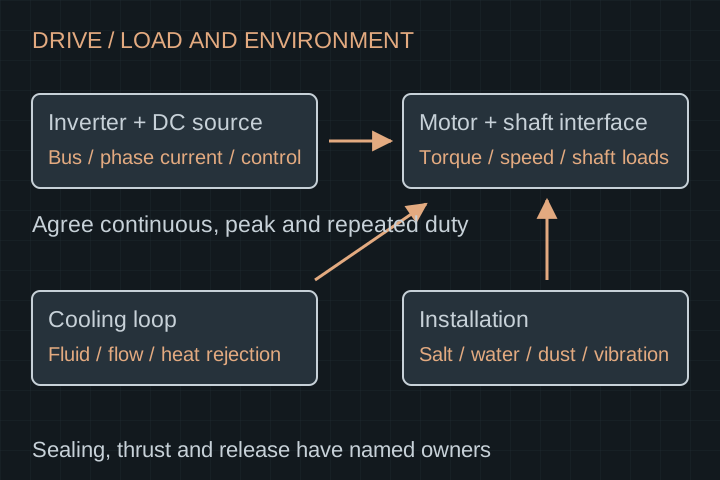
Fit the motor to the load cycle and the installation. Scope a compact drive around torque, speed, cooling, shaft loads and the environment it will actually operate in.
Component, assembly or custom motor scope · Reviewed 20 October 2026
START WITH THE CONSTRAINTS
An axial package can help when available length is limited, but cable bends, coolant fittings, bearings, couplings and service access also occupy space. Specify the complete installation envelope and load cycle before selecting a motor architecture or requesting a price.
DECISION / 01
A vehicle acceleration event, a marine cruise point and a machine’s repeated low-speed pull create different thermal histories. Send a time series or representative cycle for your own project.
DECISION / 02
Provide minimum and maximum bus voltage, inverter current definitions, speed range and regenerative operation. Agree winding, feedback and temperature-sensor compatibility together.
DECISION / 03
Distinguish freshwater, salt spray, immersion, dust and washdown. Specify sealing, materials, cooling-loop separation and validation conditions rather than assuming a generic IP label covers every exposure.
REQUIREMENT → EVIDENCE
Use this proposed review matrix to identify what is known, what needs a test and who can approve the result. Acceptance limits are agreed for your project.
| Application | Requirement to resolve | Evidence to request |
|---|---|---|
| EV / performance vehicle | Acceleration, sustained grade or track duty; gearing and regenerative envelope | Torque–speed–time test points with bus, current and temperature conditions |
| Marine propulsion | Propeller torque curve, sustained cruise and manoeuvring / reverse duty | Continuous-duty thermal record and thrust / coupling load review |
| Off-highway / mobile machinery | Repeated launch, low-speed high torque, stalls and idle recovery | Representative cycle, protective limits and restart conditions |
| Package and shaft | Axial length, diameter, mounts, coupling and external bearing arrangement | Controlled interface drawing, load assumptions and service clearances |
| Cooling loop | Fluid, inlet temperature, flow, available pressure and heat-rejection capacity | Thermal acceptance at defined boundary; leak and pressure checks if commissioned |
| Environment | Actual water, salt, dust, vibration and corrosion exposure | Agreed test method, acceptance criteria and post-test inspection |
For an assumed 20 kW shaft-output target at 2,000 rpm, T = 9,550 × 20 / 2,000 = 95.5 Nm. This is one operating point. A propeller curve, reverse manoeuvre and continuous cooling boundary are still needed.
The example is an input conversion, not a 20 kW product offer. It does not calculate electrical input, hull performance, endurance or thermal capability.
SUPPLY AND INTEGRATION
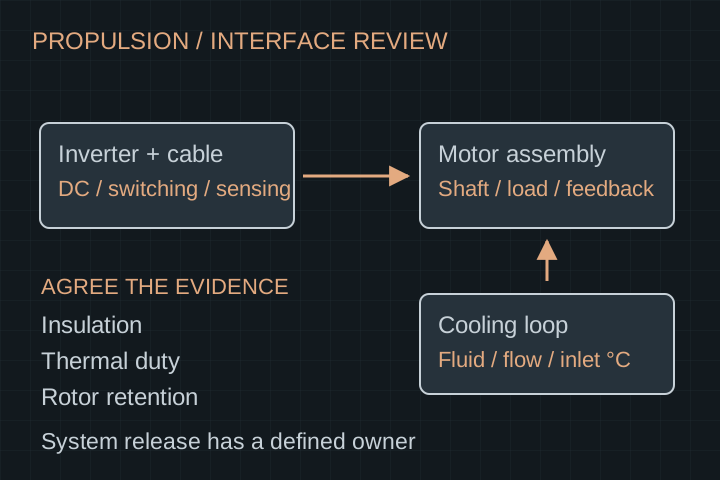
| Interface | Motor work package | System integration work package |
|---|---|---|
| Electrical / controls | Agreed winding data, feedback and temperature-sensor interfaces | Inverter selection, tuning, torque commands, interlocks and regeneration limits |
| Mechanical / thrust | Mounting and shaft interfaces; only the loads explicitly accepted | Gearbox, propeller or wheel loads, coupling and external bearing design |
| Thermal / environmental | Defined cooling connections, materials and commissioned verification | Heat exchanger, pumps, filtration, hull / chassis installation and exposure specification |
| Vehicle or vessel release | Quoted sample and inspection deliverables | Installation validation and applicable vehicle / vessel approval decisions |
REVIEW / 01
Selected operating points, peak duration, repetition and hot-start conditions.
REVIEW / 02
Revisioned electrical, shaft, mount, cooling and environmental requirements.
REVIEW / 03
Agreed bench evidence, exceptions and remaining integration tests before system release.
No vehicle approval, marine class approval, ingress rating or corrosion qualification is stated. Controllers and system commissioning are included only when explicitly named in the agreed work package.
Review air-gap and inspection planningFIRST CONVERSATION / NON-CONFIDENTIAL
Your inquiry opens the requirements discussion. We first identify missing inputs and the requested deliverables; feasibility, price, schedule and verification work need a project-specific agreement.
The contact form carries this application and source page. Request an NDA before sharing proprietary drawings. It records requirements and does not upload CAD or execute an agreement.
Discuss your drive requirements Download the application worksheetReview current, battery window and winding requirements.
Review 48 v / 96 v development programReview bus, insulation, cooling and controls integration.
Review high-voltage propulsion programDefine bearing seats, sealing interfaces and inspection datums.
Review precision housing scopeThese pages organize custom development inquiries rather than released stock models. Send duty, bus voltage, envelope, cooling and quantity to establish feasibility, scope and a project-specific quotation.
Only if controller supply, compatibility review and commissioning are explicitly included. Name the proposed inverter, current limits, feedback and control interfaces in the brief.
Evaluate the propeller torque–speed curve, thrust and moment loads, shaft support and intended speed range. A suitable electromagnetic operating point does not by itself establish a complete direct-drive installation.
No such suitability follows from the cooling method. Specify the fluid circuit, materials, salt exposure, sealing and required evidence. Direct seawater circulation must be reviewed explicitly rather than assumed.
Do not assume so. Bus range, speed, current, insulation and inverter limits must be evaluated for the proposed winding and duty. The two program pages provide separate input checklists.
Provide a non-confidential operating brief, scope, quantities and acceptance needs first. Separate prototype engineering, tooling, sample inspection and recurring units in the quotation request; any schedule and price remain subject to review.
Reviewed by the YokelessMotor editorial team on 20 October 2026. Tables, examples and responsibility splits are our proposed planning tools. External sources provide context, not evidence of our tested hardware or certification.
Sections 3.2–3.6 illustrate model-specific shaft, winding, output and cooling interfaces. Its limits are manufacturer-specific, not claims for YokelessMotor.
Manufacturer context for compact axial packaging and its direct-oil-cooling approach. YASA performance claims and cooling design are not transferred to our projects.