MOTOR DEVELOPMENT / OEM & R&D

Custom axial flux motors.
Choose the program around your duty.

Start with a complete motor, a frameless rotor–stator kit or a component-led development scope. These programs organize engineering inquiries; voltage and power bands are development targets rather than released model specifications.

Discuss a motor project
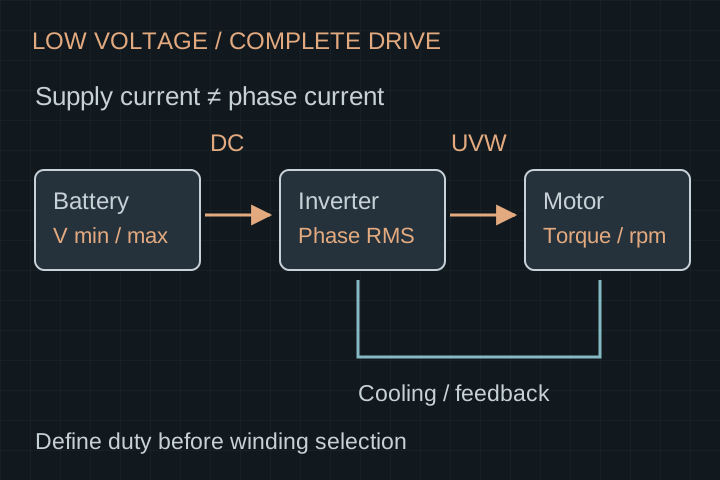
System concept from battery through inverter to axial motor, with separate DC bus and phase current and a cooling return path
48–96 V DC / 5–30 kW inquiry targets

48–96 V motor programs

For OEM teams developing mobile machinery, compact vehicles, heavy UAVs or marine prototypes, a thin motor package is only one constraint. Bring the battery window, load cycle and cooling budget together before choosing a winding or inverter.

Review this program
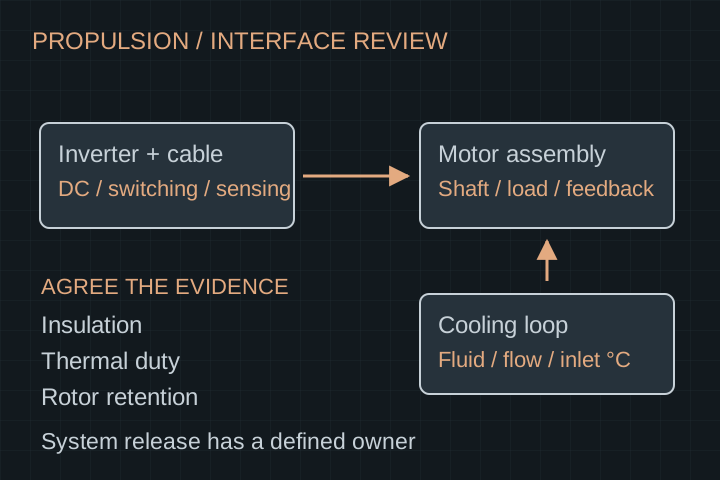
Propulsion review showing motor and inverter interfaces, a separate coolant loop and a list of insulation, feedback and mechanical acceptance boundaries
Up to 800 V DC / 50–200 kW inquiry targets

High-voltage propulsion programs

Review a compact propulsion package around continuous shaft output, the actual DC voltage window and the available cooling loop. Define motor, inverter and integration responsibilities before turning a target power into a prototype specification.

Review this program
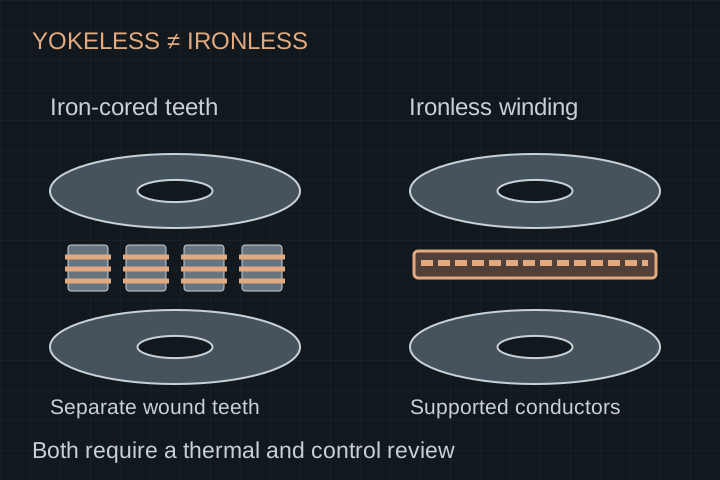
Section comparison between an iron-cored yokeless segmented stator and an ironless supported winding, both between rotor discs
A distinct topology / application-led development

Coreless & ironless axial programs

For precision-motion OEMs and research teams evaluating an ironless active winding, start with the allowable disturbance torque and thermal duty. Removing stator teeth changes the magnetic circuit, conductor support and drive requirements; it does not eliminate every source of torque ripple.

Review this program

Agree what is inside the quote.

Complete motor

Define housing, bearings, shaft loads, cooling connections, electrical terminals, feedback and assembly acceptance. Inverter and system commissioning are separate line items unless included explicitly.

Frameless kit

Define stator and rotor supply, mounting datums and retention. Identify who owns bearings, alignment, the final air gaps and hot or dynamic testing.

Component-led development

Keep your electromagnetic design and commission a defined stator, rotor, PCB or housing scope. Agree revision control, DFM deliverables and component inspection.